
The weakest link in the AI supply chain has moved, and it is no longer (just) silicon
Early in my career as a marine engineer on oil tankers, I learned that a ship rarely stops because of its main engine. It stops because a generator trips or a cooling water pump fails, and at that point, nobody asks how good the engine was. I have found myself returning to that lesson while reading this month’s data centre news, because the AI industry is discovering the same hierarchy of dependencies at a far larger scale. For three years, capital has flowed into every layer of the stack, from chips and memory to switchgear and cooling, yet a chain performs only as well as its weakest link, and that link is now electricity and, increasingly, water.
Capital cannot buy a grid connection
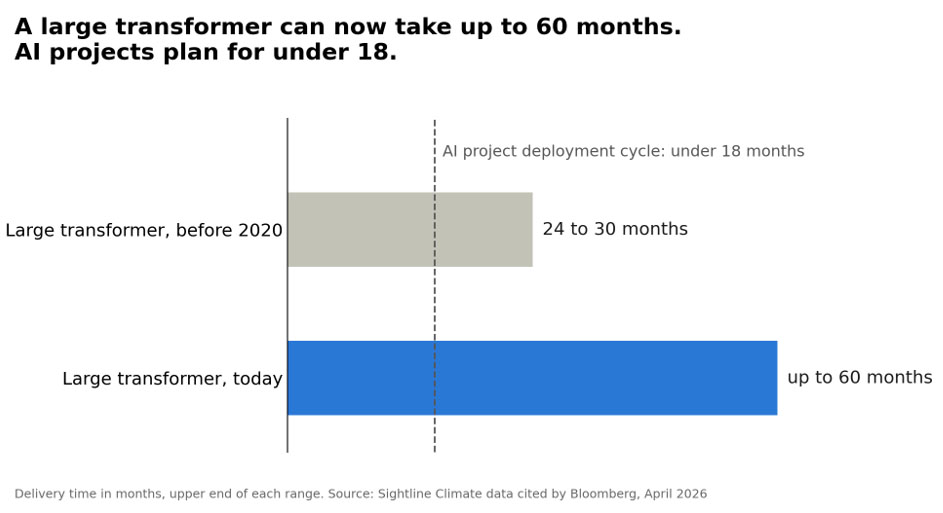
Microsoft’s decision to withdraw as anchor tenant for Nscale’s Loughton campus in Essex illustrates the point well. Grid officials told the developer that power may not reach the site before the 2030s, and that was enough to unwind a flagship commitment, even though Nscale’s contracted value has grown from $100 million to over $103 billion in roughly two and a half years. Balance sheet strength did nothing to shorten a queue governed by utilities and regulators rather than investors. The pattern extends well beyond the UK. Bloomberg reported in April that nearly half of the data centres planned in the United States for 2026 are being delayed or cancelled, with grid connections and equipment shortages among the principal causes. A large transformer that once arrived within 24 to 30 months can now take as long as five years, while AI projects are routinely scoped to go live in under 18.
None of this means the semiconductor constraint has eased. Taiwan Semiconductor Manufacturing Company’s third-quarter revenue rose 41.2% to $46.72 billion, and its CEO still describes demand as well ahead of supply. The difference lies in recoverability. Fabs are expensive but can be built on a known timeline, whereas a new transmission line or a secure water source depends on utilities, planning authorities and local communities, none of which respond to capital on the same schedule.
The industry is already designing around the constraint
NVIDIA’s own response at GTC Berlin is telling. Its DSX POD reference design packages an AI factory into modular containers that, according to the company, can be operational on site in 14 days rather than six months, provided the site’s power and cooling are already in place. That qualifier carries the real message, because the hardware now arrives faster than the infrastructure beneath it. NVIDIA also claims its platform can reduce cooling water use by up to 100% and deliver the same output with up to 30% less power. These are vendor claims that will need independent validation, but the direction matters, since even the company that sells the chips is now optimising for power and water. For investors and operators, the practical implication is that diligence on any data centre project should begin with the power-on date, the transformer order and the source of cooling water, well before the GPU order.
India’s window to get it right
India can apply this lesson before the constraint bites. Savills estimates operating capacity at about 1.8 GW and expects it to pass 7 GW by 2030, close to a fourfold increase, while S&P Global projects that 60 to 80% of Indian data centres could face high water stress this decade. In Devanahalli near Bengaluru, groundwater extraction is reported at 169% of the permissible limit, and at least eight data centres have been approved there since 2013. NITI Aayog’s evaluation framework, released on 14 October, moves in the right direction by asking states to verify power and water availability before approving projects and by recommending that facilities above 20 MW be ready for automated demand response. I would like to see that discipline go further, with renewable supply contracted before a site is selected, cooling designs that do not draw on groundwater, and location decisions driven by where power and water exist rather than where land is cheapest.
Ultimately, this is a question of sustainable growth, meaning growth that the grid and the water table can carry rather than growth at any cost. Projects that ignore that boundary are the ones that will stall, however good the engine. I would value hearing from colleagues on the power and water side whether this discipline is taking hold on the ground.
Author: Ankur Rastogi
President at AGR Knowledge Services Pvt. Ltd.