
India Feeds 1.4 Billion People. But Who Is Feeding the Farmer?
India feeds 1.4 billion people. It is a civilisational feat, renewed every single season, in every district, on every farm — large and small. Yet behind this extraordinary achievement is a quieter, more uncomfortable statistic: the average Indian farmer earns less than ₹10,000 a month.
That farmer wakes up each morning and makes a series of decisions that will determine whether that number moves up or down. Which crop to plant this season? When to irrigate, and how much water does the soil actually need? Will it rain today, or is that cloud formation a false promise? Is that yellowing leaf the early sign of a nutrient deficiency, or the beginning of a pest outbreak that could wipe out an entire harvest?
For generations, these decisions were made through a combination of intuition, accumulated experience, and wisdom passed down from father to child. That knowledge system is not primitive — it is, in many ways, deeply sophisticated. But it is also operating in a world that is changing faster than any single generation can absorb: erratic monsoons, shifting pest cycles, volatile commodity markets, degraded soils, and a climate that no longer behaves predictably.
<₹10KAverage monthly income of an Indian farmer |
10 acresScanned by a drone in just 20 minutes |
6 depthsSoil moisture readings from a single sensor |
What is changing right now — and changing at a pace that demands serious attention — is the quality and accessibility of data available to support those decisions. A drone can scan ten acres in twenty minutes and produce a canopy health map that would have taken agronomists days to replicate on foot. A sensor embedded in the soil can detect moisture at six different depths. An AI model can synthesise weather patterns, soil data, humidity content, and crop stress signals to tell a farmer in a village in Vidarbha what to do tomorrow — not next week, not next season, but tomorrow.
The question is no longer whether technology can help Indian agriculture. That debate is settled. The question now is harder, and more consequential: Is it actually reaching the farmer or the Farmer Producer Organisation (FPO)? Is it changing behaviour at the ground level? And is it building the kind of trust that can, over time, complement — and in some decisions, replace — intuition shaped by decades of experience?
Where Is AI Actually Creating Measurable Impact?
Before we engage in a discussion about the future, intellectual honesty demands a reality check. The agri-tech space has not been short on ambition, investment, or pilots. It has, however, been uneven in its delivery of measurable outcomes. There is a meaningful distinction between technology that has created genuine impact — improvements in yield, reduction in input costs, better risk management, higher net farm income — and technology that remains, for all practical purposes, a proof of concept waiting for the right conditions to scale.
From a research standpoint, the impact has been clearest in three areas.
1. Precision Input Management
AI-powered crop advisory and drone-based field scanning are reducing the blanket application of fertilisers, pesticides, and water — one of the most significant cost drivers for the smallholder farmer. When a farmer applies inputs based on data rather than assumption, over-application drops, input costs fall, and soil health improves over the medium term. This is not theoretical. Across multiple field deployments, variable-rate input application driven by remote sensing data has shown input cost reductions in the range of 15–30%, with yield maintenance or improvement. For a farmer operating on ₹10,000 a month, a 20% reduction in input expenditure is transformational.
2. Early Stress Detection
Multispectral drone imagery and satellite data combined with ground-level AI models are enabling early detection of crop stress — whether from pests, disease, water deficit, or nutrient imbalance — before it becomes visible to the naked eye. The economic value here is not just in the intervention cost; it is in the losses avoided. A pest outbreak detected seven days earlier than traditional scouting methods allows for a targeted, lower-dose response rather than a panic-driven field-wide spray. The asymmetry of that outcome — small investment in early detection, large avoidance of loss — is exactly the kind of economic logic that justifies adoption.
3. Market Linkage and Price Discovery
AI tools that aggregate mandi price data, demand signals, and logistic constraints are beginning to help farmers — particularly those operating through FPOs — make better post-harvest decisions. When to sell, where to sell, and how to store for maximum value are questions that have historically been answered by intermediaries whose interests are not always aligned with the farmer’s. Data is beginning to rebalance that equation.
Technology Is Ready. But Are We Ready to Trust It?
We spend considerable energy discussing AI capability — accuracy rates, model architecture, satellite resolution, sensor sensitivity. These are important conversations. But there is a prior question that does not receive enough boardroom attention: as humans, are we — and more critically, are farmers — ready to act on advice from a machine?
Consider what we are actually asking. We are asking a farmer who has cultivated the same land for generations — who knows its micro-topography, its drainage behaviour in a heavy rain, which corner gets waterlogged in July — to accept a recommendation generated by an algorithm that has never set foot on that land. The request is not unreasonable. But the ask is significant, and we should not underestimate it.
The Generational Intuition Dilemma
Farming intuition is not superstition. It is pattern recognition built over decades of close observation. When an experienced farmer in Maharashtra says the rabi crop should be sown three days later than usual this year based on how the soil is behaving, that is a genuine signal, not noise. The challenge — and the opportunity — for AI is not to dismiss that intuition, but to augment it with data at a scale and depth that no individual observation system can match.
The farmers who are adopting data-driven advisory are not abandoning their experience. They are using technology to validate and extend it. A farmer who receives a drone-based stress map and finds it confirms what he already suspected about the north corner of his field does not distrust the technology — he finds it credible. That is how trust is built: one confirmed prediction at a time.
Language as an Entry Point for Trust
One of the most underappreciated dimensions of agricultural technology adoption in India is language. We are a country of twenty-two official languages and hundreds of dialects. An advisory system that communicates in English — or even in standard Hindi — is already operating at a disadvantage in districts where farmers think, communicate, and make decisions in Marathi, Telugu, Kannada, or Bhojpuri.
Multilingual platforms that operate natively in the farmer’s language are not simply a user experience improvement. They are a trust infrastructure. When a recommendation is delivered in the language a farmer grew up speaking — when the idiom, the unit of measurement, the reference point is familiar — the cognitive barrier between receiving advice and acting on it drops substantially. Language is not a feature. It is the foundation.
The Institutional Trust Channel
Perhaps the most strategically important insight from field research is this: trust does not always travel directly from technology to individual farmer. It often needs an institutional mediator. When a recommendation comes from an FPO that a farmer has been a member of for ten years — an organisation whose leadership he knows, whose track record he has observed — the recommendation carries a different weight than one arriving via an app on a phone he received six months ago.
This is not a weakness of the technology. It is a signal about how change happens in high-trust-required environments. The implication for scale strategy is significant: building the technology stack and building institutional credibility must proceed in parallel. FPOs, cooperatives, and agricultural extension networks are not distribution intermediaries to be bypassed on the road to direct-to-farmer engagement. They are trust infrastructure. The most effective deployments we have observed are those that have invested as seriously in the institutional layer as in the technological one.
From High Risk, Low Returns — to Low Risk, High Returns
Let me be direct about why this work matters at a structural level.
The conventional wisdom in risk and return theory is that high risk is the price of high returns. That trade-off is acceptable — even celebrated — in capital markets, where the participant has diversified portfolios, risk management instruments, and the ability to absorb a bad year. The Indian smallholder farmer has none of these buffers. A bad monsoon, a pest outbreak, a market crash in commodity prices — any one of these events in isolation can push a farming family into debt. The combination of all three can be generational.
Farming, as currently structured for millions of smallholders, is a sector of high risk and low returns. That is the status quo we are working to change.
The thesis behind building AI tools for agriculture is not to make farming more technologically impressive. It is to engineer a fundamentally different risk-return profile for the farmer. When AI-driven advisory enables more accurate input application, it reduces the risk of over-spending on fertilisers that do not improve yield. When drone-based early detection catches a pest outbreak before it spreads, it reduces the risk of catastrophic crop loss. When data-driven market linkage enables better price discovery, it reduces the risk of distress selling. In each case, the intervention is about risk reduction — and the consequence of that risk reduction is higher net returns.
Low risk, high returns. That is not a financial product. That is what good agricultural technology, properly deployed, should deliver to the farmer who has always been told that the price of being a farmer is accepting the uncertainty of the weather, the market, and the soil.
We have the data. We have the models. We have, increasingly, the infrastructure to deliver recommendations to farmers at scale. The remaining work — and it is substantial — is the work of trust, of institutional partnership, of language, and of ensuring that the value created by these systems flows primarily to the farmer, not merely through the farmer to the next layer in the value chain.
The Next Chapter Is Not Just About Technology. It Is About Adoption.
Every major technological transition in agriculture — the Green Revolution, hybrid seeds, drip irrigation — has followed a similar arc. The technology precedes the adoption. The adoption precedes the trust. And the trust, once established, is what creates scale and lasting impact.
We are, by my assessment, at the midpoint of that arc in Indian agri-tech. The technology is ready — and improving at a pace that was not imaginable a decade ago. The adoption is beginning — measurable not just in pilot programmes but in observable behavioural change among farmers who have experienced the technology for multiple seasons. The trust is being built — slowly, unevenly, but genuinely, through institutional channels, through multilingual access, and through the most powerful proof point of all: a recommendation that worked.
The work ahead is not primarily technical. It is organisational, institutional, and deeply human. It is the work of designing systems that speak the farmer’s language — literally and figuratively. It is the work of building FPO capacity to mediate between data systems and decision-makers in the field. It is the work of ensuring that the economics of these platforms do not inadvertently extract value from the very communities they are designed to serve.
India’s farmers have always carried the weight of feeding a nation. The question for our generation of researchers, technologists, and institutional builders is whether we will use the tools now available to us to lighten that weight — and to finally deliver on the promise of a farming life that is not defined by risk and scarcity, but by data, dignity, and the returns that both deserve.
The Mission: Low Risk. High Returns. For Every Farmer.
AI, drones, and data are not the end state — they are instruments. The end state is an Indian farmer who earns more, loses less, and makes better decisions with confidence. That is the outcome we are building toward.
Title – “IMC Agriculture Conclave 2026 – Appreciation Note”
Dear Mr. Rastogi,
Warm greetings from IMC Chamber of Commerce and Industry
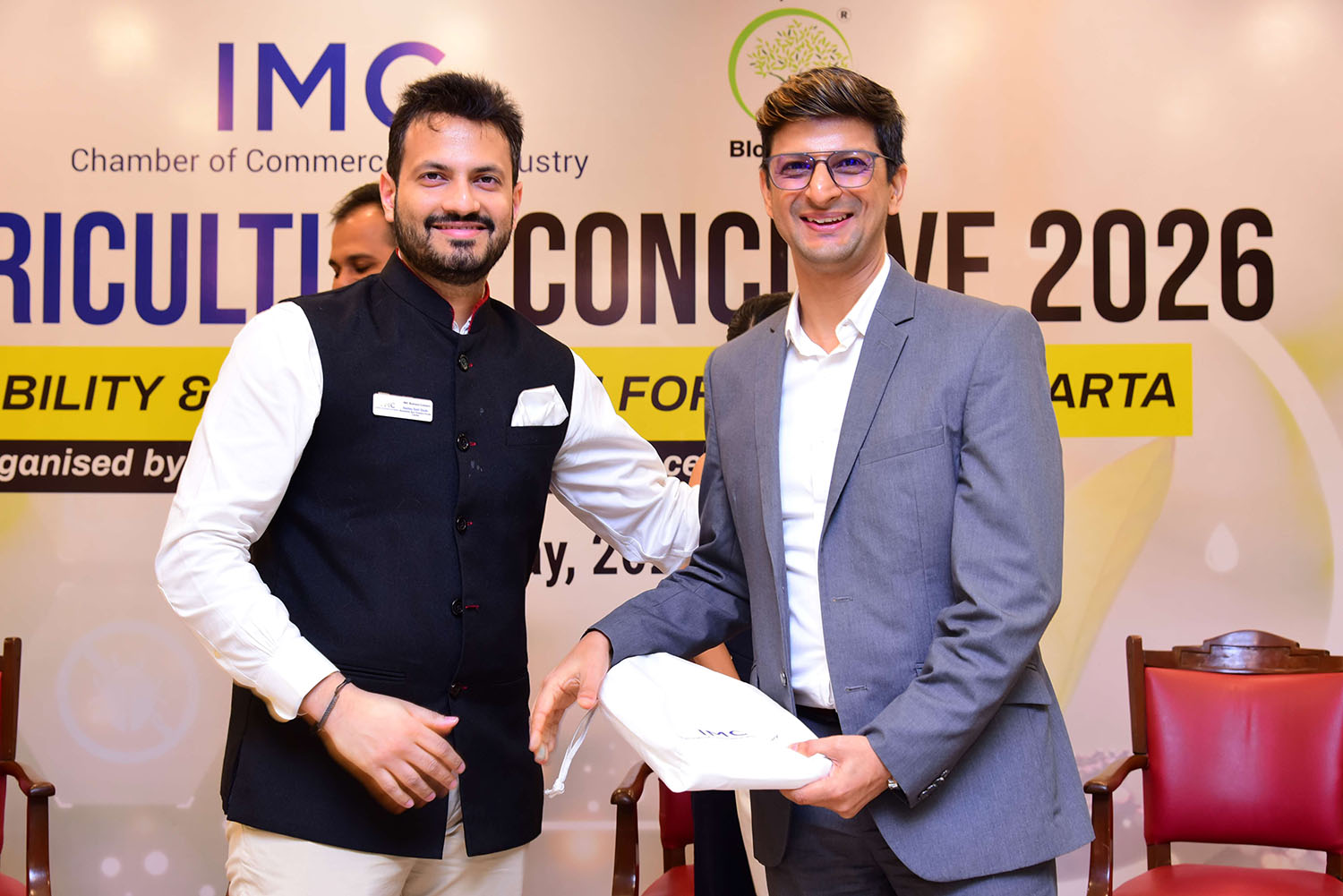
On behalf of the IMC, we would like to extend our sincere appreciation for your valuable contribution to the IMC Agriculture Conclave held on 15 May 2026.
Your role as a moderator at the Panel on AgriTech & Digital Innovation – “AI, Drones & Data: Transforming Indian Agriculture was deeply appreciated by all participants. Your discussion brought together diverse viewpoints on AgriTech and digital innovation and added tremendous value to the discussions and were highly relevant to the evolving landscape of Indian agriculture.
We are grateful for the time and effort you invested in preparing for the conclave and sharing your expertise with our delegates. Thank you once again for your support in making the conclave a great success.
We look forward to staying connected and to future opportunities to collaborate.
