

By R. Subramaniam and Divesh Khemani | AGR Knowledge Services
Every 16th of September, the conversation around the ozone layer tends to repeat itself. A reminder that the hole above Antarctica is healing. A nod to the Montreal Protocol. A line about how international cooperation once solved a genuine planetary emergency. It is a good story, and it deserves to be told. But after two decades of watching how environmental policy actually moves through industry, I think the more useful story this year is a different one: what happens after the treaty works.
This year’s World Ozone Day carries a specific milestone. It has been ten years since the Kigali Amendment to the Montreal Protocol came into force, and the UN has built its 2026 theme, “Global Action for a Cooler Planet,” around that anniversary. Kigali did not deal with ozone-depleting gases directly. It went after hydrofluorocarbons (HFC), the refrigerants that replaced the original ozone-depleting substances but turned out to be extremely potent greenhouse gases in their own right. Countries agreed to cut HFC use by more than 80% over roughly thirty years. The UN’s own estimate is that full implementation could avoid up to 0.5°C of global warming by 2100. That is a genuinely large number for a single treaty amendment.
But treaties do not just change behaviour. They change where money goes. And that is really what this piece is about.
Cooling is now where chemicals and energy meet
Cooling, once you look closely, sits at the exact point where chemicals and energy meet. The refrigerant is a chemical product. The compressor that runs the system draws electricity. The equipment itself needs to be manufactured, installed and serviced. As countries move toward low- (global warming potential) refrigerants and more efficient cooling systems, all four of those pieces start attracting capital at once, and increasingly in markets that are still building their cold-chain and cooling infrastructure from scratch rather than retrofitting it.
The bigger number is coming from energy
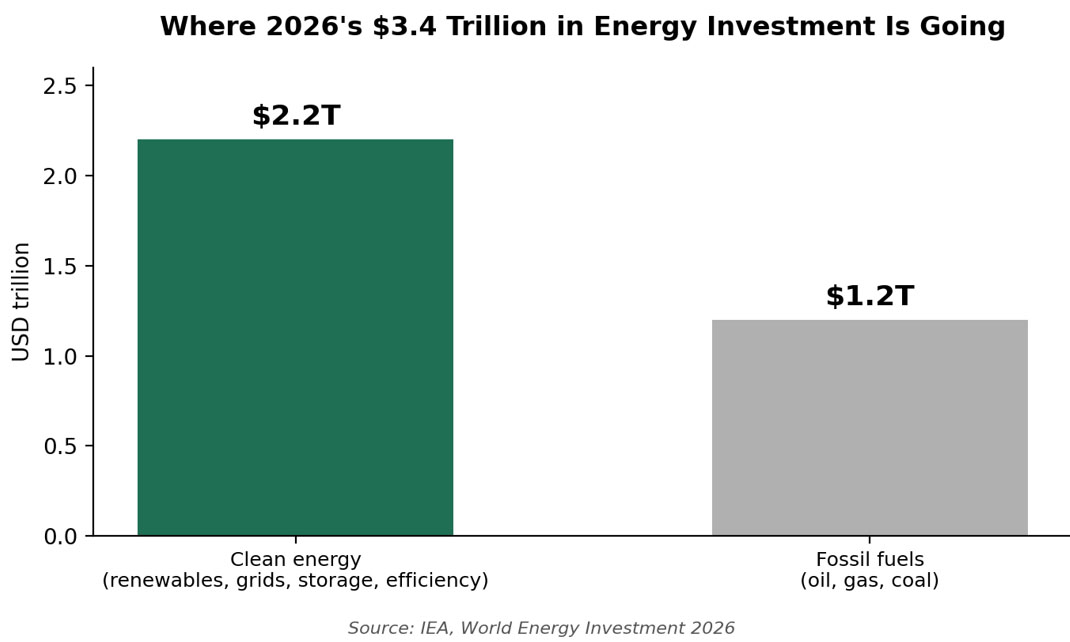
The IEA’s World Energy Investment 2026 report puts global energy investment at roughly USD 3.4 trillion this year, up 5% from 2025. Of that, about USD 2.2 trillion is going toward renewables, nuclear, grids, storage, efficiency and electrification, nearly double the USD 1.2 trillion still going into oil, gas and coal. That is not a story about fossil fuels vanishing overnight. It is a story about where the marginal dollar is choosing to go, and for an energy-intensive sector like chemicals, that marginal dollar shapes every major capital decision made from here to 2030.
India offers a close-to-home example
India offers a useful, close-to-home example of what this looks like in practice. The Union Budget for 2026-27 set aside ₹20,000 crore (approximately US $2 billion) over five years for carbon capture, utilisation and storage across five sectors, chemicals among them, alongside power, steel, cement and refineries. The same budget proposed three new dedicated chemical parks, backed by an initial ₹600 crore (approximately US $0.72 billion), aimed squarely at building domestic manufacturing capacity rather than importing critical intermediates. Put those two decisions side by side and a pattern emerges: India is trying to grow its chemical industry and lower its carbon intensity in the same breath, not as two separate projects on two separate timelines.
The honest caveat
None of this is guaranteed to scale on schedule. Clean electricity still needs to get cheaper and more reliable in the markets that need it most. Carbon transport and storage infrastructure is mostly still on paper. Skilled technical capacity and durable policy support, the kind that survives more than one budget cycle, remain the real bottleneck, not the technology itself.
Why the anniversary still matters
Which brings me back to why this day still matters, even for people who spend their careers in balance sheets rather than atmospheric science. The Montreal Protocol proved that a well-designed regulation can quietly rewire an entire industry over a generation. Kigali is proving it again, this time with cooling and, by extension, chemicals and energy. The companies that treat this as a compliance obligation will spend the next few years reacting to rules. The ones that treat it as an investment thesis are already positioning for 2030. That, to me, is the real anniversary worth celebrating on the 16th of September.
Author:
R. Subramaniam is Head of Sales and Divesh Khemani is the Vice President – Business Research in the Mumbai office of AGR Knowledge Services. Both are chemical engineers with deep insights into the chemical and energy sectors.