
This newsletter is based on an interactive session held at IMC where our VP, Ali Asgar Sanwarwalla was one of the speakers.
While, we all know, or at least believe that we know, the reasons we like to travel, it is still worthwhile to explore some of these in order to understand if AI will bring a tectonic shift across the entire travel, tourism and hospitality sector or will the impact be felt more in some areas and less in others. So, why do we travel besides work and the usual logistical reasons in life? The usual answers that emerge are for the joy of it, to escape the humdrum nature of everyday, for a quick getaway to reenergize oneself, for meaning, curiosity and discovery or even perhaps for spiritual reasons and for asserting one’s own being by making connections with oneself and others. These answers are important because they have a sense of timelessness attached to them and seem not to waver with technology. The same can be said for hospitality. But the way we satisfy some of our motivations to travel has certainly changed. Whether it is for the better or for the worse, you can be the judge.
To move forward, sometimes it is better to move behind a little and for the purpose of this discussion, let us move all the way back to 2001 when a humble browser extension emerged to find what the internet audience then considered “cool” web pages. The name of this browser extension was StumbleUpon. By 2007, StumbleUpon was named one of the 50 best websites by Time. By 2009, StumbleUpon drove more traffic to webpages than other social media sites in the US like Facebook, YouTube, Twitter etc. By 2010, StumbleUpon had around 10 million members. By 2011, StumbleUpon is believed to have one billion stumbles per month. By 2012, StumbleUpon announced that it had over 25 million registered users. By 2018 StumbleUpon was dead and it shut down. If you are wondering why this example is relevant to our discussion, I request you to refer to the motivations to travel. Are the reasons people search for customized content similar? The words escape, meaning, connections, respite etc. once again appear. In the light of this example, consider how far AI as technology could go? From the sci-fi examples of virtual travel and immersion in a Star Trek Holodeck to the more obvious and already in place agentic AI and AI based automation and recommendation which is already at different stages of implementation.
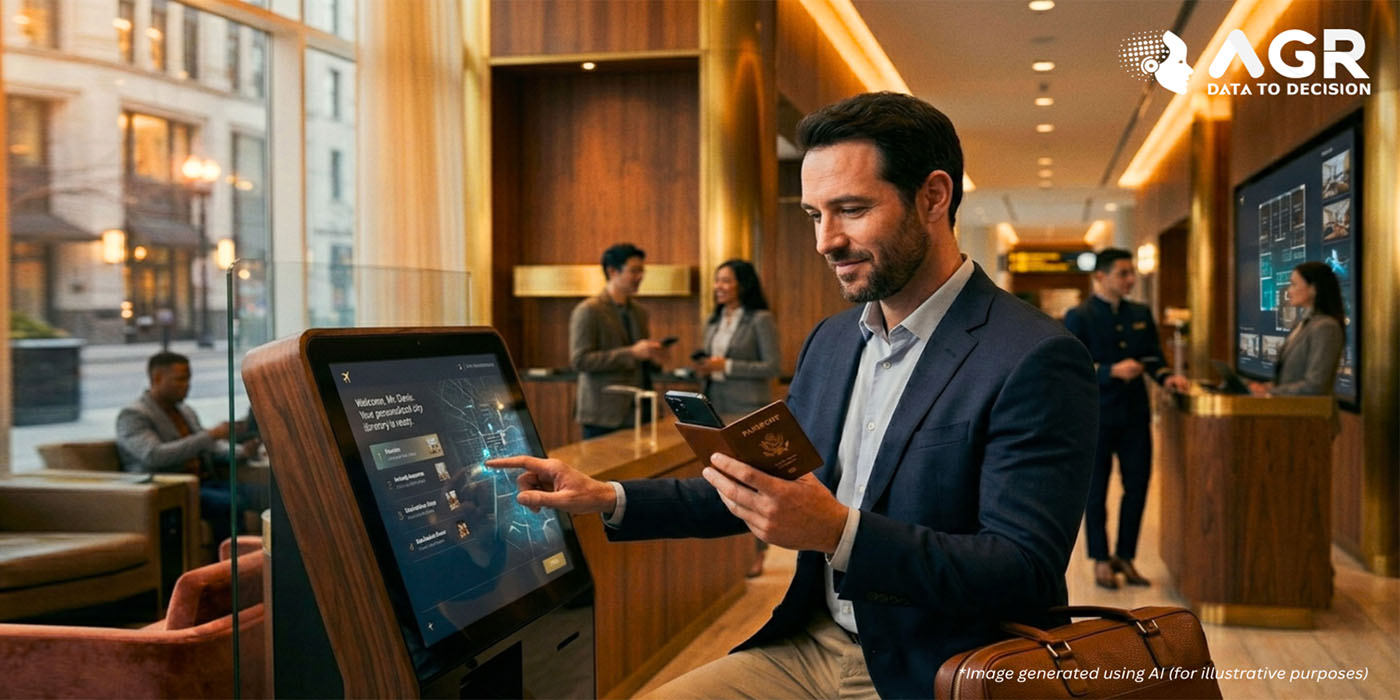
If we look at adoption in the industry currently, we can already see examples of implementation and AI use cases in areas of labour and operational optimization with chatbots, virtual assistants and automation taking up a large chunk of repetitive work. Energy and resource management is another example. On the marketing side, demand forecasting, inventory management, personalization and customer acquisition as well as dynamic pricing are examples of areas where AI is being actively used and increasingly adopted. Companies adopting AI report between 3% to 15% revenue growth and cost savings from 10% to 20% or in cases even more. From the consumer side as well, personalization including personal suggestions, tailor-made packages, rooms and experiences that consider customer needs and preferences etc. are already par for the course and expected.
KLM’s BlueBot which is an AI powered assistant on social media and other platforms, is widely considered as a success and a use case for other brands to follow. AI powered assistants or real time price checks and trip planners using LLMs are already features in many booking sites like Expedia and Booking.com. MakeMyTrip has a GenAI-powered assistant called Myra that handles thousands of daily conversations. Marriot is known to use AI for dynamic pricing and for personalization.
With these examples and plenty of use cases as well as with the adoption of AI from the customers themselves, there is no reason to doubt the impact of AI in this industry. However, one needs to be a little circumspect and understand that AI and automation come with challenges and in some cases, may not be the right solution for a business, at least from the customer-facing point of view. We are not just talking about the need for human experience and the need for hospitality to have a human face but also about the fact that AI can optimize for things that a human would not. For instance, a dynamic pricing system may optimize natural disasters and tragedies for revenue or may personalize to the point where personalization seems invasive and a violation of privacy. There are also instances of what we call AI slop where AI recommends destinations based on hallucination or incorrect data or based on influencer social media content that has been optimized. The problems with AI thus involve not just issues of emotional context, meaning and empathy but also operational issues which need to be addressed failing which companies could face lawsuits or other consequences as have happened in the past where chatbots have made commitments on behalf of the company for which the company has been held liable.
Some AI stalwarts and enthusiasts believe that the issues with AI are teething troubles and with adequate checks – like humans in the loop, careful testing and scaling up, adoption only for the right use cases as opposed to adoption for adoption’s sake and auditability as well as with having the correct data sets – all the issues can be ironed out. This is true to a very large extent but one must also remember that while there is a – rapid adoption of AI, we as embodied beings have a unique set of spoken and unspoken desires and connections which need that good old and timeless human touch and human experience and therein lies the caveat that needs to be heeded in an otherwise clear case of AI adoptability.
About the author-
Ali Asgar Sanwarwalla is Vice President at AGR Knowledge Services, with over 15 years of experience in digital and social media research, analytics, and consulting. He specializes in helping global brands build digital strategies, uncover consumer insights, community and brand reputation management, and leverage AI-driven social listening for strategic decision-making. He currently leads the company’s social media insights and analytics practice, overseeing marketing, sales, and operations.