
India has spent 75 years importing the energy that powers its economy. One war in the Middle East just made fixing that non-negotiable and revealed how much India has already quietly built. Here is the full story: where we were, what the war changed, and what comes next.
CHAPTER 1
The Uncomfortable Truth India Lived With
Consider this: India effectively exports a sizeable portion of its wealth every year through energy imports. Nearly 85 paise of every rupee spent on oil leaves the country, flowing to suppliers such as Saudi Arabia, Iraq, the UAE, and Russia. With close to 85% dependence on imported crude, this translates into an annual outflow of ₹22 lakh crore ($24 billion USD), exceeding the nation’s combined spending on defense, education, and healthcare.
Every government knew it. Every budget speech mentioned energy security. Every five-year plan had targets for renewables. And yet, for decades, the honest answer to the question ‘what happens if the oil stops flowing?’ was: we don’t have a good plan.
The reason was geography and geology. India has very little oil of its own. What it does have is large deposits of coal, thorium, solar irradiation across three hundred sunny days a year, 7,500 kilometers of coastline ideal for offshore wind. Oil, by contrast, you can just buy. And for decades, buying it was cheaper than building the alternative. So, India bought, and deferred, and bought some more.
But underneath this dependence, something else was happening. Quietly, without much fanfare, India was building. Slowly at first, then faster.
What was being built
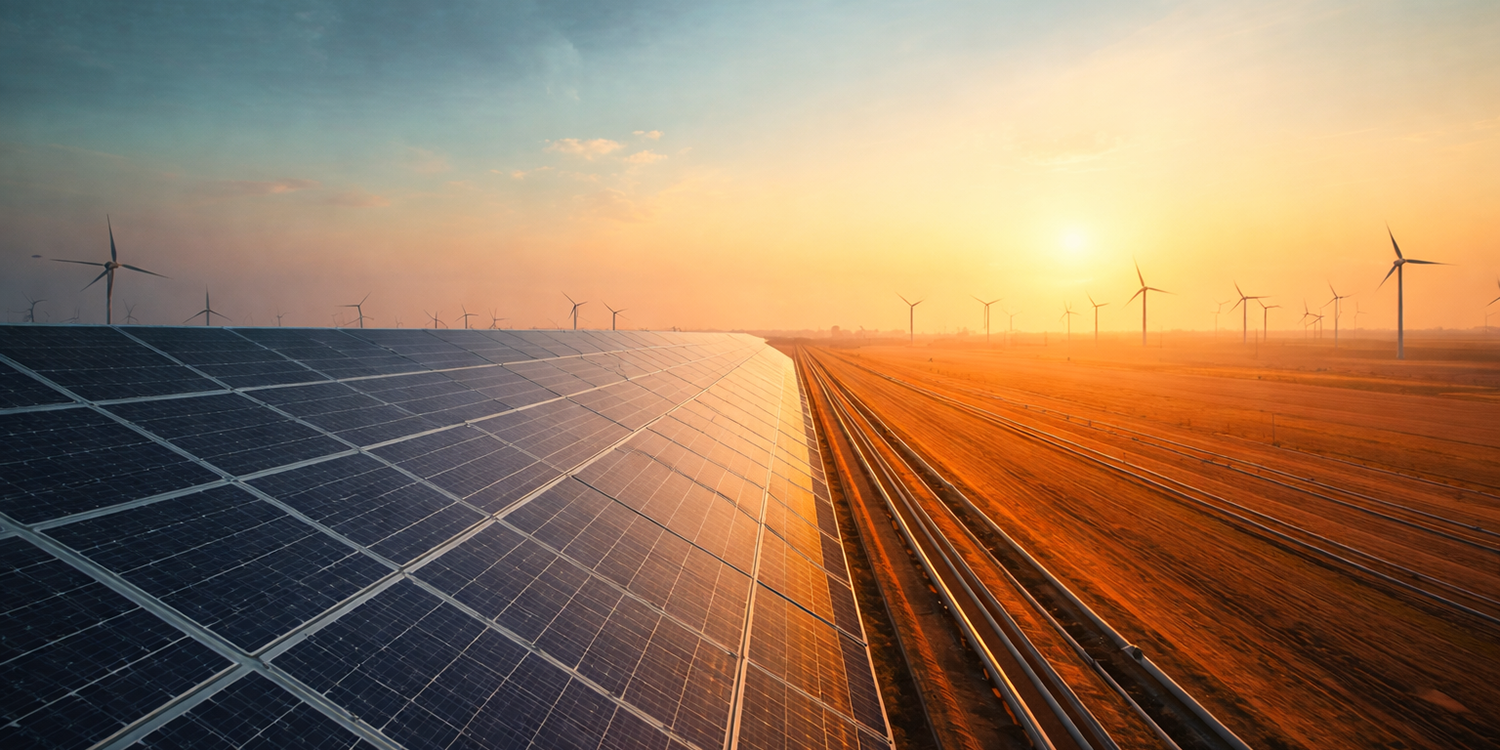
By April 2026, India had crossed 150 GW of installed solar capacity, a number that would have seemed absurd in 2014 when the country had barely 3 GW. Solar stood at 150 GW, wind at 56 GW, and for the first time in history, more than half of India’s total power capacity came from sources that don’t burn anything. Clean energy crossed 52% of total installed capacity.
The ethanol story is even more underappreciated. India blended ~20% ethanol into petrol by 2026, up from just 1.5% a decade ago. That single shift has saved roughly $19–20 billion in foreign exchange and now the ambition is even higher as recently, Union Minister Nitin Gadkari has indicated a roadmap toward 30% blending, which could significantly deepen these gains, potentially driving incremental savings of $25–30 billion annually by further reducing crude import dependence.
On the manufacturing side, India’s solar push has moved beyond installation to scale production. Domestic solar module manufacturing capacity now stands at ~150–160 GW annually, while the government’s ALMM list (approved pool of domestic manufacturers) has crossed ~110 GW. The message is clear: India is not just deploying solar; it is building the capability to supply it.
And then there was Kalpakkam. On April 6, 2026, India’s Prototype Fast Breeder Reactor achieved criticality. Put simply, this is a next-generation nuclear reactor that can generate more fuel than it consumes, making it far more efficient than traditional reactors. This is a major milestone, placing India among a very small group of countries with this capability and it has long-term implications: lower dependence on imported fuel, more stable base-load power, and the potential to strengthen India’s position in advanced nuclear technology over time.
India, sitting on some of the world’s largest thorium reserves, had just taken the first step toward a nuclear fuel cycle that requires almost no imports. Dr. Homi Bhabha conceived this three-stage plan in the 1950s. Seventy years later, Stage 2 had begun.
CHAPTER 2
The Shot That Changed Everything
To understand why February 28, 2026, mattered, focus on one critical location, the Strait of Hormuz, a narrow 33 km waterway through which 20% of the world’s oil and a major share of global LNG flows. For years, it was seen as a theoretical risk, a single chokepoint that could disrupt the global economy if blocked.
That risk became reality when US and Israeli strikes on Iran triggered a swift response, effectively shutting the strait. Within days, oil prices surged past $100, and a significant portion of global LNG supply disappeared as Qatar halted exports. Countries like Kuwait, Iraq, and Bahrain were unable to ship oil despite higher prices, while even Saudi Arabia and the UAE could only partially offset the disruption.
What it meant for India specifically
India’s exposure was acute. With 59% of crude imports coming from West Asia and the import bill already at ₹22 lakh crore ($24 billion USD) a year, every week of Hormuz disruption added billions of dollars to the national bill. Indian refineries, which are optimised for Gulf crude, could not simply switch to other suppliers overnight. India was not watching this crisis from a safe distance. It was sitting at the table, holding a very large bill and very few alternatives.
But here is the thing about crises: they clarify. The ambiguity around energy security – ‘yes, we should fix it, eventually, when it is more convenient’ evaporated in days. The next chapter of India’s energy story was no longer a policy discussion. It was a national emergency with a deadline.
CHAPTER 3
What Comes Next — and Why It is Bigger Than Energy
Most of the commentary on India’s energy transition stops at the first-order effects: import less oil, build more solar, save foreign exchange. These are real, important, and the right starting point. But they are also the obvious part — the headline, not the story beneath it.
The far more interesting question is: what changes in India when energy stops being a vulnerability? The answer, it turns out, is everything, the economy, manufacturing, agriculture, and India’s role in the world. These effects are slower to arrive, but they are larger and more permanent than the energy savings themselves.
Second-order effect: the rupee becomes a different currency
The impact of reducing India’s oil dependence goes far beyond energy, it quietly reshapes the entire economy. At the most basic level, a lower oil import bill means less pressure on the rupee. When fewer dollars leave the country, the currency becomes more stable, which in turn helps contain inflation and reduces the need for sharp interest rate hikes. Over time, this translates into cheaper loans, more investment, and a more predictable economic environment.
At the same time, cheaper and more reliable domestic energy begins to change the economics of manufacturing. Industries like steel, aluminium, chemicals, and fertilizers, long constrained by high power costs become far more viable. In effect, energy independence lowers one of India’s biggest structural bottlenecks, making large-scale industrial growth more achievable.
The benefits extend to rural India as well. The energy transition is turning farmers into energy producers, through ethanol, solar power, and biogas, creating an additional and more stable source of income. What emerges is a broader shift: energy independence is not just about reducing imports, but about strengthening the currency, unlocking industrial capacity, and improving livelihoods across the country.
THIRD-ORDER EFFECT: INDIA’S FOREIGN POLICY GETS UNSHACKLED
The deeper impact of energy independence goes beyond economics—it begins to reshape India’s global position. Today, much of India’s “strategic autonomy” is influenced by its reliance on imported energy, particularly from geopolitically sensitive regions. As this dependence reduces, India gains greater freedom to take positions based purely on its national interests, rather than energy security concerns.
At the same time, India’s relationship with the Gulf is likely to evolve. While lower oil imports reduce one layer of dependence, they also bring second-order effects, particularly around remittances and employment for Indian workers in the region. This makes it even more important for India to build strong domestic industries that can absorb and create jobs as global energy dynamics shift.
Finally, energy independence positions India not just as a consumer, but as a future supplier of solutions. With progress in areas like solar manufacturing, green hydrogen, and advanced nuclear technology, India is building capabilities that other emerging economies will increasingly need. Over time, this creates an opportunity for India to export not just energy technologies, but also the frameworks and expertise required for large-scale energy transitions—marking a shift from dependence to influence on the global stage.
THE BOTTOM LINE
The Starting Gun Has Fired
Here is the simplest way to think about this. For 75 years, India’s energy vulnerability was a slow bleed, expensive, manageable, easy to defer. The Hormuz crisis turned it into a fast bleed. The difference between a slow bleed and a fast bleed is not the wound, it is the urgency of the response.
What the crisis has done is compress the timeline on finishing the job: modernising the grid, fixing the DISCOMs, scaling storage, building the critical mineral supply chains, and deploying EVs not as a pilot programme but as a national network.
The second and third-order effects such as a stronger rupee, cheaper industrial power, an additional income stream for farmers, a foreign policy unshackled from the oil import bill, and an India that exports clean energy technology to the developing world, these are not hypotheticals. They are the logical downstream consequences of a transition that is already underway. They arrive on a 2030–2040 timeline, not overnight. But the infrastructure being built today is what makes them possible.
Energy independence is not the destination. It is the starting gun for something far larger. The question is not whether India will get there. It is whether it will treat the next five years with the urgency they deserve.
About the author
Kartik Gosiya is Senior Analyst at AGR Knowledge Services. He works in our Investment Research team, with a focus on macroeconomics, energy markets, and long-term economic trends. His work looks at how global developments and energy transitions shape India’s growth over time.