By Sangita Iyer, Senior Manager | AGR Knowledge Services
The global data centre industry is expanding rapidly, but capacity growth is only part of the story. AI is reshaping how the next generation of data centres will be designed and built, as higher compute densities place greater demands on power, cooling and supporting infrastructure.
APAC is gaining ground as the capacity mix shifts
North America remains the world’s largest data centre market, supported by a strong hyperscale ecosystem, mature colocation capacity and established infrastructure supply chains. Our discussions with data centre stakeholders across major global markets indicate that the geographic balance of capacity is beginning to shift.
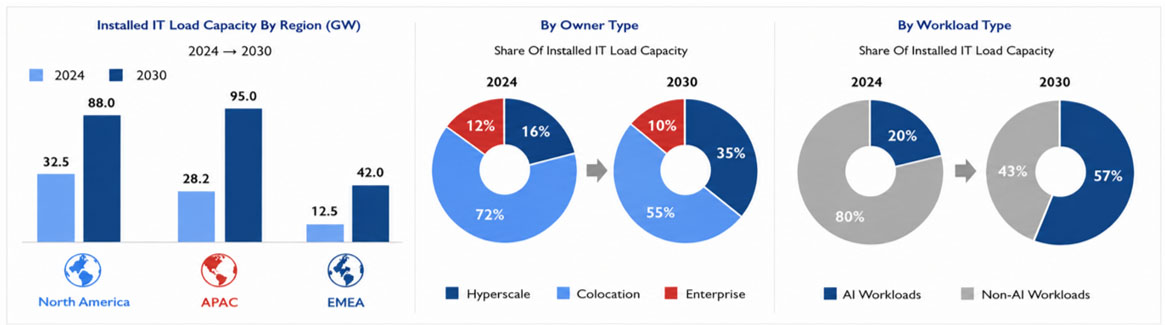
APAC is emerging as a key growth region and could be broadly on par with or marginally ahead of North America in installed IT load capacity by 2030. China is expected to remain the region’s largest market, reaching over 60 GW by 2030, while India is scaling rapidly and is expected to reach around 12 GW. Southeast Asia is also attracting investment as operators expand across a broader set of markets. Within markets, capacity remains concentrated around major data centre hubs, where access to power, connectivity and supporting infrastructure continues to influence capacity additions.
The capacity mix is changing alongside this geographical shift. Colocation and hyperscale infrastructure are expected to account for a growing share of capacity additions, while AI workloads are becoming a much larger part of data centre capacity. Together, these developments are changing not only where capacity is being added, but also what that capacity needs to support.
Exhibit 1: Global data centre capacity is expanding and changing in composition
Higher compute density is changing infrastructure requirements
Traditional data centres were largely designed around racks consuming tens of kilowatts. GPU-intensive AI clusters are pushing rack densities into hundreds of kilowatts, while the industry is already preparing for megawatt-class systems.
The impact extends across the facility. More power must be delivered within a smaller footprint, and substantially more heat must be removed. At the same time, grid availability and pressure to bring capacity online faster are influencing where and how new data centres are developed.
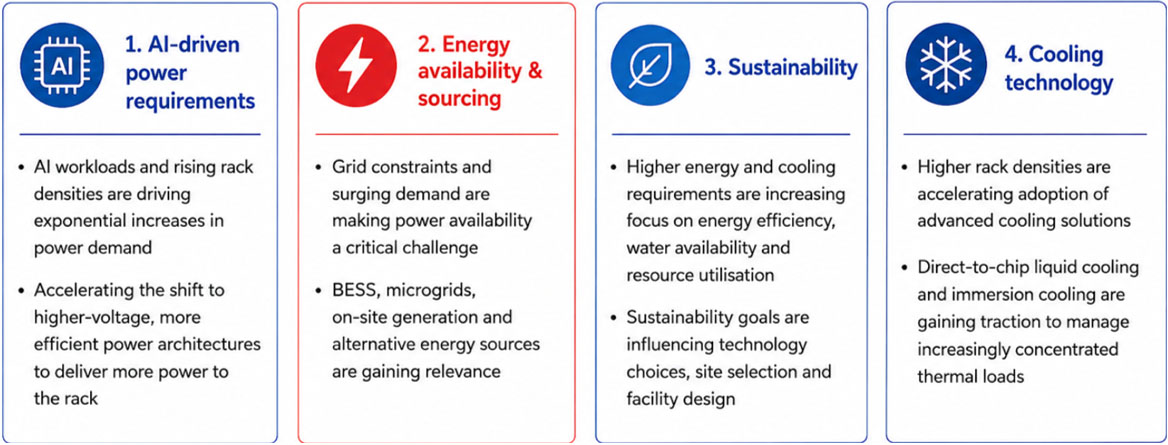
Beyond higher compute density, several key trends are shaping infrastructure requirements, including AI-driven power demand, energy availability and sourcing, sustainability and advances in cooling technology.
Exhibit 2: Key trends reshaping data centre infrastructure
Power and cooling architectures are evolving together
Higher rack loads are driving the need for more efficient approaches to power distribution. The industry is progressing from conventional AC systems towards 48/54 VDC architectures, while higher-density AI deployments are accelerating the development of ±400 VDC and 800 VDC architectures.
NVIDIA, for example, is developing an 800 VDC architecture for megawatt-scale AI racks, while the Open Compute Project is advancing high-voltage DC and rack-scale power architectures.
Multiple architectures are expected to coexist as operators balance installed infrastructure with new AI requirements. The shift is about more than voltage. The broader objective is to deliver significantly more power to the rack while reducing losses and infrastructure footprint.
Cooling is changing alongside power. As rack densities increase, direct-to-chip liquid cooling and immersion cooling are gaining relevance for AI deployments. Rising power and cooling requirements are also increasing the focus on energy efficiency, water availability and resource utilization, bringing sustainability more directly into infrastructure design. Increasingly, compute, rack, power and thermal design need to work as one system.
New architectures are reshaping the infrastructure ecosystem
These changes have implications well beyond servers and GPUs (Graphics Processing Units). New approaches are emerging around how power is delivered to high-density racks. Sidecar-based designs can bring power conversion and distribution closer to the IT load, while longer-term developments around higher-voltage DC and solid-state transformers could enable greater integration of power functions. This is creating new requirements across transformers, switchgear, UPS (Uninterruptible Power Supply) systems, power electronics, busways, cables and interconnects.
The opportunity extends into cooling, across CDUs (Coolant Distribution Units), cold plates, pumps, manifolds and heat exchangers. Power availability is also increasing the relevance of BESS (Battery Energy Storage System), microgrids, on-site generation and intelligent energy management.
As these architectures evolve, the opportunity for infrastructure suppliers is moving beyond simply providing equipment. Increasingly, differentiation could come from how technologies are configured and integrated to address higher power densities, new cooling requirements and the need to bring capacity online at scale.
Where will the next opportunity emerge?
The industry is already responding across power, cooling and facility infrastructure. The question now is where the next challenge will arise as these solutions scale.
In some markets, it will be access to grid power or water availability. Elsewhere, it could be scaling liquid cooling, integrating new power architectures, qualifying equipment, securing critical components or bringing increasingly complex facilities online quickly enough.
These developments are creating opportunities across the broader data centre ecosystem. Electrical equipment and power distribution providers stand to benefit from rising power requirements, while the transition towards liquid cooling is expanding the addressable opportunity for cooling solution providers. Grid constraints are opening opportunities around energy storage, on-site generation and energy management, while increasing facility complexity could raise the importance of engineering and integration capabilities.
As one challenge is addressed, another emerges. The companies best positioned for the next phase of growth may therefore be those that can anticipate the next infrastructure bottleneck and develop the technologies and solutions needed to address it.
Author: Sangita is a Senior Manager at AGR Knowledge Services with 7+ years of experience in market and opportunity assessment, competitive intelligence and growth strategy. She has worked across industrial and infrastructure sectors, including assessing growth opportunities and evolving infrastructure requirements across the data centre ecosystem.